


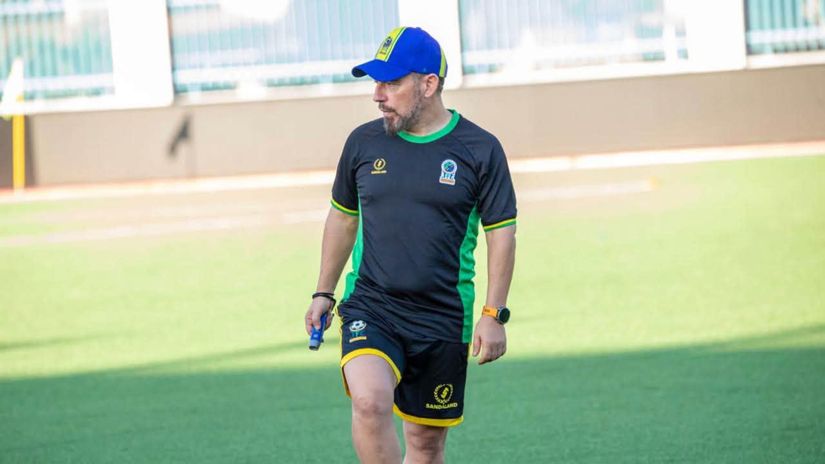
For Ngorongoro Heroes head coach Mario Rivera Campesino, building a successful football system is not a project that can be measured in months, or even a couple of years.Download our Mozzart Sport app for more news“It is not something that is going to come in one or two years. It is a long process. It is something you have to do for many years if you want to be successful,” the Spaniard told Mozzart Sport.Rivera speaks from experience. The UEFA Pro Licence holder began his coaching career in the youth ranks at Spanish side CD Leganés, before working with Betis San Isidro, and San Martín de la Vega.##NAJAVA_MECA_9962375##He later worked within Atlético Madrid’s technical setup, and coached Unión Collado Villalba and Los Yébenes San Bruno, before moving into international and club football in Asia.His career has since taken him to Brunei, where he coached the U21 national team before becoming senior head coach, and India, where he worked with East Bengal both as an assistant and head coach. He is now part of Tanzania’s technical setup.The 48-year-old believes one of the most important parts of youth development is simply giving young players somewhere to play.CAF President Patrice Motsepe to visit Nairobi as AFCON 2027 preparations intensifyHe pointed to the atmosphere surrounding the current CECAFA U20 qualifiers in Dar es Salaam, where the Ngorongoro Heroes are playing in front of home supporters, as an important source of motivation for young footballers.Tanzania opened their campaign with a 3-0 victory over Rwanda at Uhuru Stadium, with Faraji Kayanda, Djuma Abushiri and Evastus Lukanima scoring. They face Ethiopia in their second and final Group A match on Saturday, with the result carrying significant weight in the race for a place in the knockout stage.For Rivera, however, packed stands are only one part of a much larger development picture.Kariobangi Sharks latest graduate reveals two lessons learnt after senior team promotionAs a Spaniard, he has seen first-hand the structures that have helped produce one of the world's most successful football systems. Spain are the reigning European and World champions, having won Euro 2024, before lifting the 2026 World Cup.Asked what East African countries could learn from Spain's model, Rivera was direct.“For me it is very clear. It is more facilities and more clubs, bigger leagues and more divisions,” he said. “A lot of the East African countries don't have the facilities, enough clubs, divisions and enough good academies for the grassroots.”Rivera believes access is particularly important at the youngest levels of the game. He argues that development cannot depend solely on talented players finding established academies, especially when many programmes require families to pay for participation.11 foreign-based players axed from Harambee Stars' final squad for 2027 AFCON qualifiers“If someone wants to support the development of football, there needs to be more academies where players don't have to pay to play,” he said.He also believes the number of clubs and competitive divisions must grow alongside academy programmes.Rivera illustrated the point using a simple numbers game. If a system currently has 300 young players, increasing that pool to 2,000 would create demand for more pitches, coaches, officials and referees, while simultaneously giving more players opportunities to compete.The objective, he argues, should not simply be to identify the best players early, but to create an environment in which a much larger number can continue playing long enough to discover their potential.##NAJAVA_MECA_9961656##“In this region we are losing a lot of players because they don't have a chance to play,” he said.That, ultimately, is why Rivera sees football development as a long-term project rather than a quick fix. More players require more teams; more teams require more divisions and facilities; and more competition creates more opportunities for talent to emerge.Why Harambee Stars striker is not overly excited despite scoring debut goal for English clubFor Tanzania, that process is already being tested on the field. The defending CECAFA U20 champions are using this year's tournament not only to pursue another regional title and a route to the 2027 U20 AFCON, but also to give a new generation the experience of competing before home crowds.Rivera's message is that the bigger prize lies beyond this tournament: building a system capable of giving thousands of young East Africans the chance to play, develop and remain in football.
28
previous post