


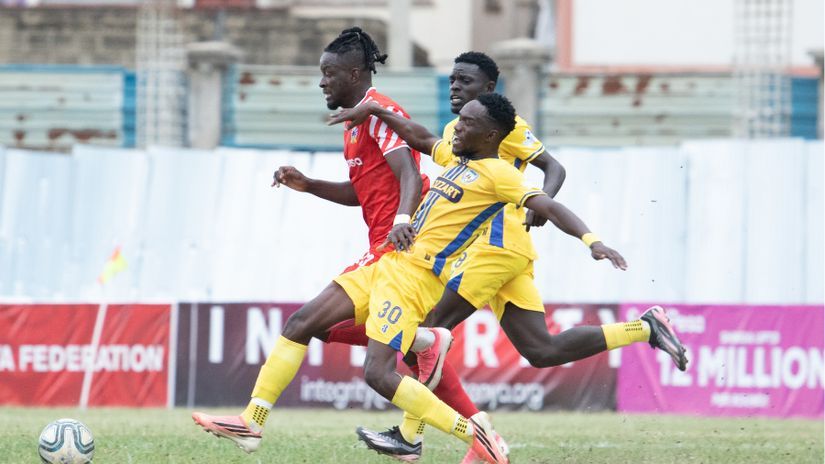
Shabana and Migori Youth shared the points in a 1-1 South Nyanza derby, extending both clubs’ run to three consecutive draws.Sigmunn Maina Irungu put Shabana ahead in first-half stoppage time, but Churchill Otieno equalised in the second half after Migori shifted towards a more direct attacking approach.Download our MozzartSport App For More NewsThe contest revolved around two contrasting methods of progression: Shabana’s positional rotations and combinations on the left, and Migori’s attempts to advance centrally before exploiting wide areas.Ultimately, the visitors’ attacking adjustments changed the game’s rhythm, exposing the importance of second balls and defensive organisation around the penalty area.##NAJAVA_MECA_10066843##Ahmed Fathi’s Shabana started in a 4-4-2, with Pavelh Ndzila in goal, Brian Bett and James Mazembe at full-back, and Sanday Herbert alongside George Onyango in central defence. Byron Otieno and Kevin Omundi formed the double pivot, while Brian Ogutu and Brian Michira occupied the wings.Sigmunn operated as an advanced playmaker alongside Alhassan Hafiz, although their movements were fluid, allowing one to drop into midfield while the other threatened the defensive line.Pamzo reveals tactical adjustments behind APS Bomet’s maiden FKFPL winSalim Babu’s Migori Youth adopted a 4-2-3-1. Victor Kamungo was protected by a back four of Maxwell Odada, Vincent Wanga, Frederick Ngiela and Woodvine Okoth. Hamvine Okoth and David Odoyo formed the double pivot, with Dennis Oguta positioned behind striker Philemon Nyakwaka.Churchill Otieno and Elly Owande provided width.Both teams sought to establish possession through midfield and short combinations, but their attacking priorities differed.Shabana used movement between the lines to connect midfield with the front two, while Migori looked to progress centrally before releasing runners in behind or delivering into the box from wide positions.The advanced positioning of both teams’ full-backs provided width but also increased their vulnerability when possession changed hands.##NAJAVA_MECA_10075938##Shabana’s build-up initially centred on a low structure involving Ndzila, the back four and the double pivot.However, Mazembe regularly advanced from left-back, transforming the attacking shape and creating overloads alongside Michira and Sigmunn.These combinations gave Shabana multiple routes around Migori’s defensive block.If the opposition full-back moved towards Michira, Mazembe could overlap into the space beyond him.If the defender tracked Mazembe, the winger could receive with greater freedom. Sigmunn supplied the connecting option, operating between the flank and the half-space to maintain short passing distances and facilitate progression.EXCLUSIVE: Harambee Stars' provisional squad to face South AfricaHis movement also altered the threat inside the penalty area. By dropping towards the ball, Sigmunn could help Shabana progress through midfield; by subsequently advancing, he could arrive late around the box or support Hafiz’s runs behind the defensive line.This positional rotation prevented Shabana’s attacking structure from becoming static.Bett also overlapped selectively, sometimes leaving a narrow 2-2 rest-defence structure. While this supported attacking width, Byron and Omundi had greater responsibility for protecting central spaces against counterattacks.##NAJAVA_MECA_10075930##Migori attempted to limit Shabana’s creativity by closing down Sigmunn when he received with his back to goal.The intention of this pressure was to prevent him from turning and directing play towards the advancing full-back or forwards.Denying him time disrupted the central connection on which Shabana’s combinations depended.Billions Kenya is likely to splash in hosting Bayern vs Ajax friendly in NairobiShabana could nevertheless progress around that pressure through their left-sided triangle, using nearby passing options to move the ball into wider channels.The relationship between Mazembe, Michira and Sigmunn was particularly valuable because it offered alternatives when the central route was blocked.Without possession, Shabana also used a recognisable pressing trigger: a pass into a Migori midfielder facing his own goal.Bayern Munich to face Dutch giants in official opening of Raila Odinga StadiumClosing down at that moment restricted the receiver’s ability to turn and encouraged backward or hurried distribution.Migori retained ways to bypass this pressure. Their full-backs advanced to support wide combinations, while longer passes towardGoalkeeper distribution through a centre-back could also lead to diagonal balls towards channel runners.These methods allowed Migori to reach attacking areas without consistently having to play through Shabana’s midfield.Shabana’s opening goal in first-half stoppage time demonstrated the value of combining direct progression with intelligent movement around the ball.##NAJAVA_MECA_10076868##After a long throw-in from Migori, Shabana regained possession in the middle third.Omundi immediately played a deeper forward pass towards Hafiz, who had drifted into the left channel. Hafiz used his strength to separate himself from Woodvine Okoth before setting up Sigmunn, who was arriving from deeper territory.That movement proved decisive. Rather than remaining alongside Hafiz against the centre-backs, Sigmunn attacked the space around the edge of the box.STARS ABROAD: Kenyan duo score in Germany, England as 'Marcelo' proceeds in Polish CupHis first touch with his right foot removed the immediate defensive challenge, allowing him to finish with his left past Kamungo from close range.The sequence exposed the difficulty of defending Shabana’s fluid front line.Hafiz provided the forward reference and link, while Sigmunn’s late arrival created an additional threat that Migori struggled to track. Shabana led 1-0 at half-time.Migori changed their attacking approach in the 56th minute, introducing Nehemiah Onchiri, Christopher Koloti and Clinton Okoth for Owande, Nyakwaka and Dennis Oguta.Koloti became a more prominent target for long passes, offering hold-up and link-up play while supporting runners advanced around him.The emphasis shifted towards earlier delivery, crosses and second-ball situations. Rather than relying as heavily on combinations through the attacking midfielder, Migori could target Koloti directly and bring Clinton Okoth into the subsequent phase.##NAJAVA_MECA_10076178##This reduced their dependence on penetrating Shabana’s midfield through short passing sequences.Shabana responded with three substitutions in the 60th minute, withdrawing Ogutu, Hafiz and Sigmunn for Kiprono, Oalo and Otanga.A further double change in the 68th minute saw Oketch and Derrick Otieno replace Omundi and Michira.These changes refreshed Shabana’s personnel but also removed key components of the combinations that had produced their strongest attacking moments.As Migori increased the frequency of direct deliveries, Shabana faced greater pressure to defend the penalty area and manage clearances.The contest increasingly depended on aerial duels, second balls and the organisation surrounding each delivery.Victor Wanyama's message to Harry Kane after winning Ballon d’OrMigori equalised in the 74th minute through a sequence that reflected their revised approach. Onchiri launched a long throw from the left, and the ball was flicked towards the back post, forcing Shabana to defend their goalmouth.Shabana cleared the initial danger, but the ball fell outside the penalty area rather than reaching a teammate in a position to secure possession.Churchill struck the loose ball from distance, finding the net past Ndzila to make it 1-1.The goal highlighted the distinction between winning the first defensive action and completing the sequence.Shabana had dealt with the immediate threat, but the space outside the box remained available for a second-phase shot.##NAJAVA_MECA_10077073##With defenders focused on the delivery towards the back post, controlling the rebound became equally important.Churchill’s injury prompted another change in the 78th minute, with Fredrick Ologi replacing him.Migori had nevertheless converted their shift towards direct play into the equaliser.Shabana nearly regained the lead in the 89th minute.Kiprono drove forward from the left, but his initial effort was blocked.Bett then attempted a trivela finish, only for Odada to clear near the goal line before the ball crossed.Six lessons learned from FKF Premier League match week threeThe chance demonstrated that Shabana could still create danger through wide progression, even after their earlier attacking combinations had been disrupted by substitutions.Migori’s recovery and Odada’s intervention, however, preserved the draw.The final result reflected the tactical evolution of the contest. Shabana initially gained the advantage through positional rotations and a well-executed direct transition, while Migori responded by prioritising aerial delivery and second balls. Neither side could establish lasting control, and both ultimately had to settle for a third consecutive draw.
41