


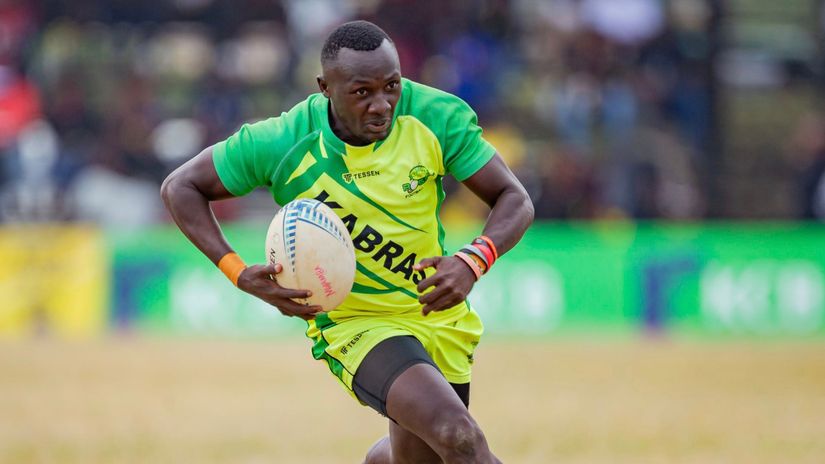
For Brian Tanga, losing was never part of the plan.It was a mindset that followed him from the moment he picked up rugby as a high school student in 2011, through his rise from Busia to Kabras RFC, and eventually to the Kenya Sevens setup, the World Rugby Sevens Series and the Olympic Games.“I have never really known how to lose. The winning mentality was already in me because I never wanted to lose. I also played for my family and my community, and that gave me an even bigger motivation to win,” Tanga reflects.At 30, however, Tanga has accepted that some battles must eventually be surrendered.Download our Mozzart Sport App for more newsLast month, after the conclusion of the National 7s Circuit, the veteran scrum-half called time on a 12-year playing career that had taken him further than he could have imagined when he first stepped onto a rugby field.From Busia to KabrasTanga's rugby journey began in 2011 while he was at Ambira High School, although he only started playing actively towards the end of his form four year.He was influenced largely by the form fours at the time, many of whom were his friends from home. ##NAJAVA_MECA_10070##Among them was Bernard Wamukoya, who would eventually leave the sport.“I first joined rugby in 2011 when I was in high school, although I only started playing actively towards the end of my form four year,” he recalled.After high school, Tanga spent about two years playing for Western Vampire, an amateur side in Busia. It was there that his potential began to attract attention.Derrick Ekurutu, now his neighbour, played a key role in helping him find his way to Kabras, while Zachariah Amatika, popularly known as Kush, took him from Busia and helped him realise that rugby could offer a future beyond high school.From cricket to Kenya’s most lethal scrum-half: The story of Samuel AsatiTanga joined Kabras in 2013 after successfully coming through trials and worked his way through the club's development structures before establishing himself in the senior side.What began as an opportunity to play rugby soon became something much bigger.“For me, Kabras is home. Having my family stay at the club for all those years- 12 years to be precise is enough evidence of that. Kabras took me to school, gave me a platform to meet people I would never have met at such a young age, and played a huge role in building the Tanga that people know today,” he said.His biggest turning point came when Kabras earned promotion to the Kenya Cup.Safari Sevens at 28: A look into the illustrious history of Africa's premier rugby festivalIt gave the young players a bigger stage on which to showcase their talent and opened the door to national-team recognition.Career built on winningTanga's career would eventually become synonymous with success.At club level, he was part of the Kabras side that won its maiden Kenya Cup title in 2016, followed by the overall National 7s Circuit title in 2017. He would later be part of the team that won five consecutive Kenya Cup titles.“My biggest achievements were winning our first Kenya Cup in 2016, winning the overall National 7s Circuit in 2017 and, of course, being part of the team that won five consecutive Kenya Cup titles,” he said.The success continued on the international stage.First Kenyan referee to officiate at IRB Series on how rugby has evolved since the 90sTanga was part of the Kenya Sevens squad that won the Singapore 7s, one of his most cherished memories with Shujaa.But even that achievement was eclipsed by one moment.“The greatest achievement of them all was going to the 2024 Olympics. That is every athlete's dream: to get the opportunity to participate in the Olympics,” he recalled.The making of number nineTanga's evolution into a scrum-half was another important part of his development.The number nine is the link between the forwards and backs, a position that demands patience, preparation and an ability to read the game.“The scrum-half position is very important in rugby because you link the forwards and the backs. It requires patience, an understanding of the game, and a lot of preparation.As an individual, you have to watch a lot of videos and review different teams because you need to understand what is happening around you. That is the responsibility that comes with playing at number nine,” he revealed.His development was also shaped by the coaches he worked under.Kenya Sevens includes 3 debutants in squad for Safari SevensAt the national level, the late Benjamin Ayimba allowed him to establish himself in the Kenya Sevens setup.Innocent Simiyu taught the importance of enjoying the game while working hard for results, while current Kenya Sevens coach Kevin Wambua has helped introduce modern-day 7s playing styles.At Kabras, the list is even longer.Urther Shikwe instilled the value of hard work, while player-coach Antony Ogot was another important influence. Mike Bishop guided the team to Kenya Cup success in 15s, Charles Cardovilis helped deliver the maiden National 7s Circuit title, and Henley du Plessis taught Tanga how to defend while converting him from a winger into a scrum-half.Mzi Nyathi built his confidence, Jerome Muller helped shape his character, and Carlos Katywa brought what Tanga describes as a winning culture to Kabras.When body began to say enoughFor all the success, Tanga's final seasons were marked by adversity.In 2024, he underwent wrist surgery, recovered and returned to play.Inside Kenya Rugby’s plan to transform Kenya Simbas and 15s rugbyThen, in 2025, he suffered a serious head injury that kept him out for almost the entire season.The setbacks changed his perspective.“Those experiences taught me that, no matter how bad a situation gets, you're the one who brings yourself back. Setbacks only make you stronger and give you mental toughness,” he disclosed.It was during this period that retirement first entered his thoughts.He had considered stepping away two years ago, but kept pushing.Eventually, however, he realised there was another generation ready to take over.“This season showed me that there are top young players who are energetic and ready to take the club to an even higher level,” he said.Friends School Kamusinga's plan to build a rugby dynastyHe pointed to Jackson Siketi, Michael Lukusi and Rayvon Ambale as players capable of taking Kabras forward.“Even after leaving 7s, I knew there would be people to replace me. Players like Siketi, Lukusi and Ambale can take Kabras even further from where I leave it.”His final 7s appearance came at the Christie 7s, where Kabras lost 5-0 to KCB Rugby in the third-place play-off after a sudden-death finish.It was not the ending he would have scripted, but Tanga's career cannot be measured by one final score.What remains after rugbyThere is one thing Tanga knows he will miss.The brotherhood.“There is something special about the bond you build with your teammates,” he said.Beyond the trophies, rugby has left him with lessons he intends to carry into life after playing.“The biggest lessons rugby has taught me are patience, resilience, and brotherhood,” he said. Shimenga Libondo sets sights on international stage with Friends School KamusingaHis advice to the next generation is equally simple.“Always be disciplined, work hard, and love training. And always remember to pray because it is God who gives you the talent, but you have to work every day to become better.”Retirement from 7s, however, is not retirement from rugby.Tanga plans to continue playing 15s while gradually transitioning into coaching.“I will still play 15s rugby and slowly transition into coaching as I wait to see what the future holds for me.”Kabras RFC humble Ugandan side to clinch Kampala 7s crownAnd when the time comes for people to look back on his career, he hopes they remember more than the trophies.“I would love my teammates, coaches, and supporters to remember me as someone who never wanted to lose and who always wanted to make his teammates better than they were yesterday,” he added.
2