


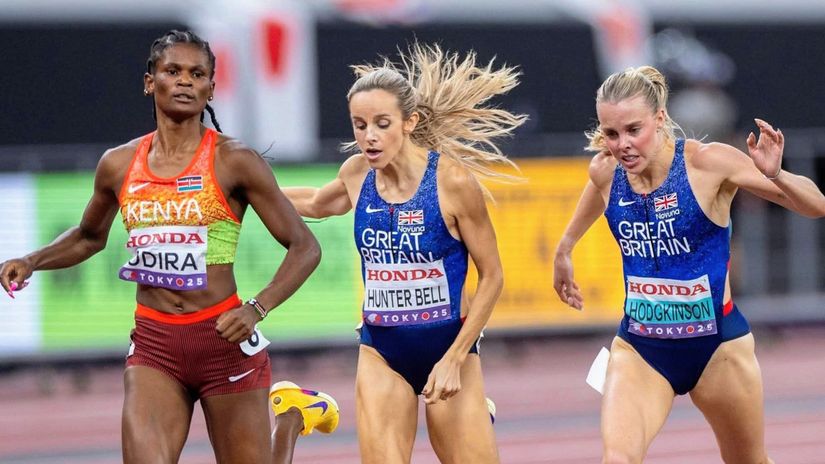
There was a time when two laps of an Olympic track were considered too much for women.Today, the women’s 800m is one of the most fiercely contested events in athletics, capable of producing world records, global stars and some of the most compelling rivalries in the sport.Its transformation has taken almost a century.Download Our MozzartSport App For More NewsThe women’s 800m made its Olympic debut at the 1928 Games in Amsterdam, alongside four other women’s track and field events. Germany’s Karoline Lina Radke won the inaugural title, but the event disappeared from the Olympic programme afterwards.Reports at the time claimed that several competitors had collapsed from exhaustion after the race. Those reports were later discredited, but the damage had been done.The event would not return to the Olympics until 1960 (32 years later), leaving women’s middle-distance running to fight its way back into the mainstream.More than 60 years later, the 800m is no longer fighting for recognition. It is fighting for the spotlight.World record attempt comes at cost as Assefa faces six-month layoffThe modern era has been shaped by athletes such as Lilian Odira, Britain’s Keely Hodgkinson and Switzerland’s Audrey Werro, while a world record that has stood since 1983 is increasingly becoming a target for a new generation.But to understand how the event reached this point, it is necessary to go back to the women who helped reopen the door.The generation that had to prove a pointAnn Brightwell was part of the generation that inherited an event surrounded by doubt.At the 1964 Tokyo Olympics, she won the 800m in 2:01:1, setting a world record and becoming the first British woman to win Olympic gold on the track.Yet the significance of the moment only became clear to her with time.Speaking to BBC Sport, Brightwell recalled her then-fiancé telling her after the race: “You don't realise what you've done.”##NAJAVA_MECA_9991882##Decades later, she understands exactly what it meant.“I didn't give it a thought at the time… but now I realise I played a very small part in women running longer distances,” she said.Brightwell competed at a time when female athletes were still battling assumptions about what their bodies could withstand. The arguments used to justify the removal of the 800m from the Olympics in 1928 had not simply disappeared.“Men weren't happy about women competing in these very high-profile events. We were considered too frail and too delicate,” Brightwell said.She also recalled the claims that women had collapsed during the 1928 race. “But it was all a lie,” she said.The obstacles were not limited to perceptionsAthletes of Brightwell's generation were largely amateurs, meaning training had to fit around jobs and other responsibilities.Brightwell was a teacher, and she was fortunate to have a school that accommodated her sporting ambitions.For many others, pursuing athletics came with a professional cost.Athletics Great Kipchoge Keino reveals how Kenya stands to profit from 2029 World Championships“Many people in my era either had to take unpaid leave or resign, or they got sacked because they were trying to juggle their sports with their career,” she said.Even training was different. Going for a run around the neighbourhood could attract curious looks from members of the public.“If I just felt like an easy run, I would run around my village, around the streets. People commented on it or tooted their horns,” Brightwell recalled.The world of elite women's middle-distance running was still being built.Brightwell's world record survived until 1967, when Australia's Judy Pollock ran 2:01.0.Then the sport set its sights on another barrier. The two-minute wall!For generations of 800m runners, two minutes became a psychological as much as an athletic barrier.Germany's Hildegard Falck broke it first, running 1:58.98 in 1971. Eight years later, Britain's Christina Boxer-Cahill joined her. At the 1979 European Cup final in Turin, Boxer-Cahill ran 1:59.05.She knew the opportunity was unlikely to last forever.“I knew this would probably be my last chance, because there were other girls in Britain trying to do it,” Boxer-Cahill told BBC Sport.For her, breaking a barrier carried a different satisfaction from simply winning a medal.“Records are great, and medals are the best, but when you break a barrier it's a fantastic feeling,” she said.##NAJAVA_MECA_9992390##Her achievement also demonstrated something important: once an apparently impossible barrier had been breached, others could begin to believe it was within reach.Boxer-Cahill compared it with Roger Bannister's four-minute mile.“Once he'd done it, everybody did it because you see what's possible,” she said.The women's 800m entered a period of extraordinary progression. Between 1971 and 1983, the world record changed hands six times.Then came the mark that has proved almost impossible to erase. A record that has survived generations. Jarmila Kratochvilova ran 1:53.28 in Munich in 1983. More than four decades later, nobody has gone faster.The record remains one of athletics' most enduring marks, although its longevity has also made it a subject of debate because of the doping environment surrounding some Eastern Bloc nations during that period.Kratochvilova has consistently denied doping allegations.For athletes competing at the time, however, the broader environment could be difficult to ignore.Boxer-Cahill was still competing at the 1988 Seoul Olympics, where she finished fourth in the 1500m behind a Soviet athlete who was subsequently banned for doping.“I'd just have loved to have been on that rostrum. I wish the Eastern Bloc system hadn't been there, but that's what it was,” Boxer-Cahill said.Her experience was a reminder that athletes could sometimes find themselves caught in circumstances beyond their control.“Politics in sport, when you're the performer, it frustrates you,” she said. “But if you get too frustrated, all it's going to do is upset your own performance,” she continued.Eliud Kipchoge on why the marathon record will keep fallingThe race has never been deeperThe most striking change in the women's 800m is perhaps not simply how fast the leading athletes are running, but how many of them are capable of running fast.Brightwell sees a depth that would have been difficult to imagine during her competitive years.“We've got not just two but several girls who are running under two minutes every time they turn out. It's stronger than it's ever been,” she said.That depth has brought the event back into the spotlight.Hodgkinson has become one of its leading figures, while Werro has emerged as another serious contender at the top of the event.And, increasingly, the conversation has turned back to the record.Werro has come within 0.42 seconds of Kratochvilova's 43-year-old mark, while Hodgkinson, the indoor world record holder, believes she is closer than ever to challenging the outdoor record.“I really do believe we can break it, but a lot of things have got to come together,” Hodgkinson told BBC Sport.The prospect has added another layer to an already fascinating event.For Brightwell, the possibility of a new world record is evidence of just how far the event has travelled.For Boxer-Cahill, it could make 2026 a landmark year for women's 800m running.“I do think the 800m world record will go in the next year or two, and hopefully this season, because we're on a real high, aren't we?” she said.Whatever happens next, the history of the women's 800m is already extraordinary.Inside Tanzania’s NBC Championship: What Kenya’s NSL can learn from the second tierAdditional reporting by BBC Sport.
3