


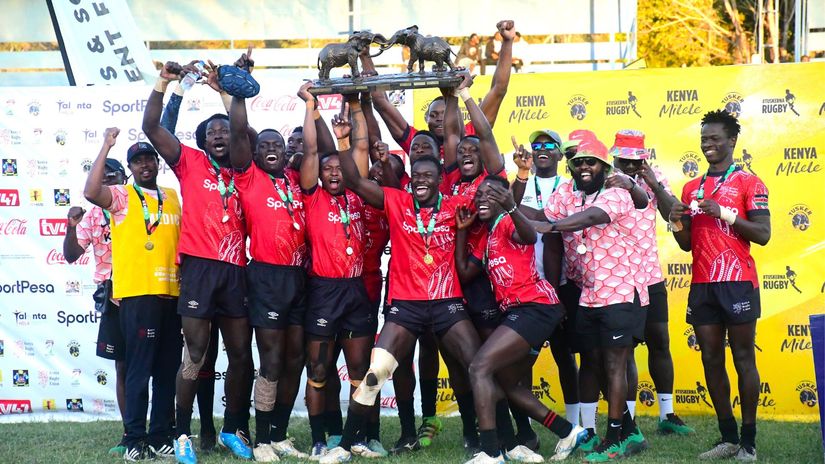
For 28 years, Safari Sevens has been a celebration of Kenya’s rugby culture, a stage for emerging talent, a magnet for international stars and, at different points in its history, a symbol of the country’s ability to bring people together through sport.Download our Mozzart Sport app for more newsFrom its modest beginnings at the RFUEA Ground in 1996 to packed national stadiums, international stars and a tournament that has travelled beyond Nairobi, Safari Sevens has experienced remarkable highs and difficult lows.Its story is one of ambition, growth, adversity, uncertainty and resilience. An idea born out of a changing rugby landscapeFirst Kenyan referee to officiate at IRB Series on how rugby has evolved since the 90sThe origins of Safari Sevens can be traced to the 90s. The overseas tours that had traditionally brought leading British clubs to Kenya were beginning to disappear, reducing the opportunities for local fans to watch high-level international rugby on home soil.The Rugby Patrons Society responded with an ambitious idea of bringing representative and invitational teams to Nairobi for a sevens tournament.The Kenya Rugby Union nurtured the concept, and in 1996 the first Safari Sevens was staged at the RFUEA Ground.##NAJAVA_MECA_10009280##Public School Wanderers from England won the inaugural title, beating Zimbabwe 40-15 in the final. Kenya claimed the Plate after defeating Uganda, while Cumbria won the Bowl against Shujaa, then Kenya’s second-string side.The tournament immediately attracted international names, among them Welsh international Colin Charvis and South Africa’s 1995 Rugby World Cup winner Chester Williams, who served as chief guest.What followed was a tournament built not by one individual, but by the combined efforts of rugby administrators, patrons, volunteers, officials, visiting teams, government and commercial partners.When Kenya began to believeFriends School Kamusinga's plan to build a rugby dynastyKenya did not have to wait long to make its mark.In 1997, coach Ham Onsando guided Kenya to its first Safari Sevens title, with Sammy Khakame leading a side that included Jeff Tolo, Felix Ochieng, Manu Okoth, Andrew Ondiek, Paul Murunga and Steve Gichuki. Kenya defeated Cumbria School Boys in the final.That victory was significant beyond the trophy.For the home supporters, it was the first clear indication that Kenya could not only host its own rugby festival but also dominate it.##NAJAVA_MECA_10010070##Safari 7s subsequently became an important pathway for Kenyan players. The tournament offered established internationals a competitive platform while allowing younger players to test themselves against serious opposition.In 2000, for example, Shujaa edged Bristol University Select 26-24 in the final, with Tony Ongoro, Arthur Indeche, Andrew “Smudge” Smith and Jeff Vilembwa among those involved.Over the years, Safari 7s became intertwined with the history of Kenyan sevens.Sidney Ashioya’s last-minute try in the rain against the Emerging Springboks in the 2010 final remains one of its iconic moments. Kenya won 17-12 after Gibson Weru created the opening.Inside Kenya Rugby’s plan to transform Kenya Simbas and 15s rugbyThen in 2019, the Kenya Morans stunned South Africa 19-14 after taking a 19-0 halftime lead.These moments gave Safari an identity beyond statistics and winners' lists. They became memories passed down through clubhouses, school rugby and the stands.From rugby tournament to social phenomenonAs Safari 7s grew, so did its place in Kenyan popular culture.##NAJAVA_MECA_10010068##For one generation, it was the Tusker Safari Sevens, an era when Kenya Breweries' backing helped turn the competition into an event that extended beyond rugby.The RFUEA Ground became the tournament's spiritual home.It was intimate, close to the action and close enough to the players for spectators to feel part of the spectacle. Around the rugby grew a festival atmosphere of music, food, entertainment and socialising.The international appeal also grew.Safari Sevens receives major Ksh14 million boost from TuskerBy 2008, Fiji and Samoa had appeared at the tournament, while legendary Fijian sevens player Waisale Serevi featured as a guest player for Shujaa.The list of international sides that passed through Nairobi became increasingly impressive: Samoa, Argentina, Georgia, Grenoble, Bristol, Ponsonby, Uganda, Namibia, Zimbabwe, Portugal, Spain, Japan, France, Canada, the British Army and the Emerging Springboks, among others.Safari 7s had become a genuine international tournament.When RFUEA became too small##NAJAVA_MECA_10010065##Success eventually created its own problem.By 2011, the RFUEA Ground was struggling to contain the crowds Safari Sevens was attracting. The tournament moved to the larger Nyayo National Stadium, allowing more spectators, corporate guests and commercial activity.The move was not a rejection of RFUEA. It was evidence of how far Safari 7s had grown.The 2012 edition demonstrated the scale of the ambition. Samurai arrived with six All Blacks and the Fijian captain, while organisers explored bringing New Zealand legend Jonah Lomu as guest of honour.Former Nairobi Polo chairman offers solution to growing rift between Kenyan rugby clubsAttendance figures from the period underline just how popular the tournament had become. Former KRU chairman Mwangi Muthee recalled queues stretching along Lang'ata Road and more than 30,000 fans entering the stadium, while former Local Organising Committee chairman Sasha Mutai put the 2012 attendance at 45,000.Safari was no longer simply a rugby competition. It was becoming a major sporting and entertainment property.2013: The peak and a moment of national tragedy##NAJAVA_MECA_10009355##The 2013 edition represented perhaps the biggest expression of Safari Sevens' ambitions.The tournament moved to the Moi International Sports Centre, Kasarani, as organisers sought to accommodate demand and strengthen Kenya's case for hosting a leg of the global sevens series.Government backing and support from major partners including Safaricom, Kenya Airways and Coca-Cola helped create the platform for that ambition.But then Kenya was struck by tragedy.Andy Cole Omollo details challenges of adapting to life in JapanOn September 21, 2013, terrorists attacked Westgate Mall in Nairobi, just a relatively short distance from the tournament venue.The attack cast a dark shadow over the city and over a weekend that had been planned around rugby and celebration.Yet Safari Sevens went ahead.Thousands still turned up. According to Muthee, 48,000 fans attended the first day, while more than 35,000 came on the final day.##NAJAVA_MECA_10009342##Sport could not erase the grief caused by the attack, but the tournament became an unexpected demonstration of resilience.For those who attended, Safari 7s became part of a broader national response, a decision to continue gathering, grieving and standing together despite fear.The difficult yearsBut no sporting property grows forever without challenges.George Nyambua provides injury update after knee surgeryAfter the heights of the early 2010s came a difficult period characterised by governance disputes, venue changes, sponsor uncertainty and declining attendance.Safaricom withdrew its support, Kenya's World Series bid stalled, and the tournament was not held in 2017.The source does not identify one single reason for the 2017 omission. Instead, it places the missed edition within a broader period of governance disputes, sponsor uncertainty and the weakening connection between the tournament's on-field product and the experience for spectators.Safari 7s returned in 2018 and 2019 at RFUEA, offering signs that the tournament could still recover its old magic.##NAJAVA_MECA_10009325##The 2018 final saw Samurai beat Shujaa 21-14 before a huge crowd. Among Samurai's players was Kurt-Lee Arendse, who would later become a world champion with the Springboks.Once again, Safari demonstrated its ability to put Kenyan supporters in front of players who were still developing into international stars.2019: A reminder of what Safari could still beIf 2018 offered hope, 2019 delivered a reminder of Safari's competitive magic.Impala RFC winger Derrick Kinyari opens up on decision to relocate to USAPlayed at a wet and muddy RFUEA Ground, the tournament produced one of its most memorable recent results when the Kenya Morans stunned a full-strength South Africa Blitzboks side 19-14.Kenya raced into a 19-0 halftime lead before surviving a South African fightback.The result was important because it restored something that had been difficult to manufacture in the years of uncertainty: belief.It reminded players that Safari 7s could still be a stage for reputations to be made, supporters that the tournament could still produce unforgettable moments and potential partners that rugby could still generate genuine emotion.##NAJAVA_MECA_10012044##The two missing editionsSafari's history also contains two notable gaps.The first was 2017, when the tournament was not held. This came during a difficult period for Kenyan rugby marked by governance disputes, uncertainty around sponsorship and a stalled bid to host a World Series event. The available history does not attribute the cancellation to one specific factor, so it is more accurate to view 2017 as part of the tournament's wider period of instability rather than attach a single definitive reason to it.The second was 2020. This one had a much clearer explanation: the COVID-19 pandemic prevented the tournament from taking place.Scottish, French sides highlight confirmed teams for Safari7sThe pandemic disrupted sporting calendars around the world, and Safari Sevens was among the events caught in the shutdown.The two missed editions therefore came under very different circumstances; one during a period of institutional and commercial uncertainty, the other because of a global health crisis.Finding a new pathSafari 7's eventual return has also involved recognising that its future may not be tied exclusively to its traditional home.##NAJAVA_MECA_10012045##In 2024, the tournament moved to Kenyatta Stadium in Machakos, taking the competition outside Nairobi and introducing the festival to a new audience.The move was significant. For a tournament with national ambitions, travelling beyond the capital offered an opportunity to build new partnerships and widen the reach of rugby.In 2025, Safari returned to Nyayo Stadium, once again putting the tournament in a national-stadium setting and demonstrating its potential as a large-scale sporting and commercial event.Menengai Oilers breakout star out to showcase ‘Gen Z game’ with Kenya 7sAnd that return proved timely.In February 2026, Nyayo hosted the inaugural HSBC SVNS 2 tournament. The event sold out, with 12 teams competing in the opening round of the pathway towards the HSBC SVNS World Championship.Historical research and archival material: Wambui Mumbi.
8
previous post